POTTED PLANTS IN TRUMP TOWER?

As I have stated, my business is Society and Nature.

Are there any potted plants in Trump Tower?

I have no idea, but I am sure there are. It is “nice” with ornamental greenery in the office. But does he notice? What does he think about Nature? Does he at all think about Nature?

On 1 June president Trump held a speech in the Rose Garden, where he declared that the United States would withdraw from the Paris Agreement of Dec 2015. – Several commentators have pointed out that the speech did not at all touch on the concerns of the Agreement: climate change and related environmental issues. The speech dealt with the efforts of other nations to undermine the US, to prevent the US from acting in full freedom, including stopping the US from expanding coal-based energy production. In the speech, the Paris Agreement takes the shape of an international conspiracy to weaken the US. After having made this “discovery” Trump explained that from now on the US will act on its own, do what it wants and what is best for it, without looking at the views of others, and without paying attention to possible climate change consequences.

Carl Bildt, former prime minister of Sweden, writes in Washington Post that with this move by president Trump the slogan “America First” became “America Alone”. Fareed Zakaria of CNN states, referring to govt sources, that president Trump has clarified that the world is not a global community but an arena where nations compete for advantage.

President Trump explained during the election campaign that he wanted to be unpredictable, to keep people guessing what his next move would be. Now we have come a bit closer to an understanding of his personality and outlook.

But what will follow? Will the US withdraw from its position as a global leader – not just as the world’s policeman, but as a promotor of peace, global balance, and economic development for mutual benefit? Should we try to get used to the thought that China will take over that job?  – One thing seems clear already: the rest of the world has become more united around the intentions of the Paris Agreement.

Meanwhile many voices of disagreement with the president’s position have been raised within the US itself. A blog post from World Resources Institute, dated 2 June, the day after, explains that more than 1000 US companies urged the president not to leave the Agreement. The blog post also presents statistics demonstrating what actually is going on in the US in terms of job creation and economic development generated by energy adaptation. The post ends with a very terse sentence: “Trump is securing his place in history as someone intent on sabotaging a global effort that has earned the commitment from nearly every other country”.

Who does president Trump think he is? And what does he think about Nature?

The Weather without Trump

Diplomats from around the world have gathered in Bonn, Germany, for two weeks, to talk about how to operationalise the Agreement reached in Paris in Dec 2015. This includes procedures for how to assess the progress made over time, to begin with the status by 2018. Of course the position of president Trump, not yet clarified at the time of closing, was hanging over the heads of all the delegates – but this uncertainty may have brought the delegates closer together and more determined to agree on something doable. According to carbonbrief.org the main issues ventilated were the global stocktake already hinted at, transparency (or how do we trust each other), and of course funding. The latter remains a contentious issue, further muddied by president Trump’s decision already months before the meeting, to cut further contributions to the so-called Green Climate Fund.

As to the tricky, and so far confusing, Carbon Market complex, the delegates were apparently still in a “brainstorming mode”, so we cannot expect much of guidance until the next meeting at least.

Now we know that president Trump backs out of the Paris Agreement and other forms of climate discussions. This is seen as tragic, catastrophic, senseless etc. But on the positive side experts speculate that his decision may not be all that consequential due to market forces and initiatives among NGOs etc that in practice bypass the official US position – but is so much more in line with the position of everybody else. (This is probably what the delegates felt while working out their conclusions.) Another positive point is that Trump’s decision may de facto reinforce the determination of most everybody else to work all the more towards what seems to be the right thing. This reaction is already  expressed in many places.  – Next stop on the road is in Nov this year, again in Bonn.

TALKING ABOUT THE WEATHER

Global warming is after much arguing accepted as a fact by a majority of citizens and scientists. Ordinary people can see signs here and there of it’s coming. I wrote earlier about the date of the cherry blossom in the Kyoto area in Japan over centuries. We get continuous news about the shrinking arctic ice cover. In Sweden the arrival of migratory birds and the first spring flowers have been recorded for a hundred years or more, and there is a tendency towards earlier arrivals. Another phenomenon is stronger winds, which can be expressed for example as the number of days per month with no or very faint wind. (I am not aware of any observations of a similar kind in Indonesia, but with increasing frequency I hear people saying “it is very hard to predict the weather nowadays”.)

We all know that the identified cause of these changes is emission of so-called greenhouse gases into the atmosphere. In December 2015 an international agreement was entered into in Paris, aiming at international cooperation to reduce the emission of such gases. USA joined. President Trump has wanted to back out of this agreement, although we are informed that there are interests working on convincing him to reconsider. In May 2016, a year ago, Mr Trump promised to “cancel” the Paris agreement. (People who are well informed about these matters explain that a cancellation is not necessary since the agreement is voluntary and non-binding and each signatory member country sets its own targets anyway.) A few days ago, the WH spokesperson Mr Spicer replied to questions from journalists saying that the reason why the President is hanging on  is that he is seeking advice from his team is to get options, and then he’ll pursue the best one. So let’s hope.

Right now and until 18 May, another UN Conference on Climate is taking place in Bonn. This time the task is to draw up rules for how the Paris agreement of 2015 is to be translated into action. The World Resource Institute WRI says “Parties need to know that climate action efforts will be measured, communicated and counted in ways that create a level playing field and build trust to reinforce the sense of common purpose.” So an element of peer pressure is foreseen – and probably necessary. The aggregate national targets so far are not enough to stay below the 2 degrees limit that has been estimated as required to stave off the worst effects of changing climate. Targets need to be reviewed, to start with. “The global stocktake” is the new buzzword here – how to assess what is really done and accomplished, first nationally and then accumulated on global level – and it does not take much imagination to see that getting this done with all members aboard must be a very complicated undertaking. However, it has to be tackled. Our future depends on it. By now that seems clear beyond reasonable doubt.

TWO WAYS OF LOOKING AT THINGS – TWO CULTURES

The Rich and the Poor is something people have talked about ever since. The educated and the uneducated have been added among many  types of contrasting “identities” that we seem to enjoy identifying.

In a lecture on May 7 1959 (58 years ago) the British scientist C P Snow made the unsettling claim that intellectual life, in Europe at least,  was split into “two cultures”: sciences and humanities, in a way he saw as harmful. Snow’s concern was that scientists knew too little about humanities – and people of the humanities knew too little about the progress of science. This split, and difference in outlook, would cause a hindrance to human progress. The two sides had difficulties in understanding each other. We need a common culture to work together. – A very vivid debate followed. I am not qualified to summarise and comment, but it seems that the passage of time has reduced the gap a bit, certainly to everyone’s advantage.

My point here is that we have for many years been living and working under the distorting influence of another gap – that between economists and “environmentalists”. (Others talk about a divorce of economic science from moral philosophy, but I stay away from “moral”, for now at least.) Decisions on land allocation, forest exploitation, and area-based production, made by investors and administrators, have been based on calculations where environmental, factors that cannot easily be expressed in monetary terms, are not included. The result is inevitably decisions in favour of financial returns to begin with, and in particular returns that will materialise early. And those decisions, through subsequent consequences here and there, have a very concrete impact on our daily life, and on the resources themselves, and our environment.

This is nothing new. Attempts have been made for long to come to grips with the “biased” procedure for bringing out data and making decisions. Still we seem to be at the same stage we were, for example in the eighties, when I was working with investments in forestry funded by the Asian Development Bank in Manila. At that time, the Environmental Impact Assessment was added to the “tool box” of analysts, but still as an “imponderable” that could not really be brought into the economist’s summary,  and to what extent this tool has affected  final decision making is not clear to me. (It has helped enhancing awareness among decision makers though, no doubt about that, and it has helped to open fora for debate.)

On April 21 I wrote about the Value of Nature: in the economic calculations Nature is made invisible. Therefore, we loose it. The discussion has continued.

At the Forest Asia Summit in May 2014 here in Jakarta, Mark Burrows, a banker with Credit Suisse, made a presentation I thought was “different” and very important – because the subject is so seldom touched –  where he “drew attention to a ‘perception gap,’ noting that the public sector, private sector, and civil society often use sector-specific jargon to describe the same problems. He called for political will to correct market failures by rethinking financial systems and holistic approaches to green growth. He emphasized green bonds as a way to favour certain types of investments. He recommended standards, third-party verification of standards, and incentives to encourage investment in sustainable landscapes”. (From a IISD page). (I wish I could get hold of his paper.) Burrow pointed out that the global financial system is the most elaborate and complicated concept that mankind has ever created, and as such impossible to understand and control in its entirety. My impression was that he was worried that we are getting misled by the complexities. – I am not aware of any reactions in the wake of Mr Burrow’s speech. But the exploration has continued; for example the concept Gross Environmental Product GEP has been introduced. How has it been applied?

Perhaps the question should be: what does economics have to do with it?

To look back a bit again: in 1973 E F Schumacher published Small is beautiful – Economics as if People mattered. Schumacher wrote: Economics, which Lord Keynes had hoped would settle down as a modest occupation similar to dentistry, suddenly becomes the most important subject of all. 

A commentator (Nom de Plume Elena) wrote: “The conception of economics as a free-standing, autonomous discipline and sphere of activity, and even as an end unto itself, is one of the costliest fallacies of our age.” This is a rather terse verdict – all the more unnerving when we consider how much economic calculus seems to guide decision making. (Note that Alfred Nobel – and his contemporaries – did not think of Economics as a science relevant to his purposes in his testament in 1901. The Sveriges Riksbank (Sweden’s central bank) established the Prize in Economic Sciences in Memory of Alfred Nobel, founder of the Nobel Prize, in 1968, a sign of an important change in social life and thinking.)

The work goes on. A team of researchers from the Center for International Forestry Research (CIFOR) and partner institutions has produced a study that makes the case for a ‘new school’ of ecosystem valuation practice, allowing for the weighing of multiple values in making land-use decisions.

“Ecosystem valuation can be difficult and controversial, and classical economists have often been criticized for trying to put a price tag on nature,” says Dr. Sander Jacobs, a researcher at the Research Institute for Nature and Forest and a lead author of the study. What is new? I will get back to this.

Is there another way but putting a price tag? A way that economists and environmentalists can agree on?
CONFLICT RESOLUTION

Here some ideas from Pinterest. I don’t know how useful they are, but some of them are at least amusing. Use of natural resources and conflict go together, that is just inevitable, and we know it has always been so.

https://www.pinterest.com/topics/conflict-resolution/?utm_campaign=interestrecommendations&e_t=84d84273da9f45b5a134e9d0cdce1217&utm_content=952489002742&utm_source=31&utm_term=3&utm_medium=2024

Land conflict is an ever-present feature in forest management and natural resource protection, everywhere and certainly in Indonesia. A growing rural population and a growing awareness of the increasing value of land are driving factors. Encroachment into areas of natural forest and into forest plantations can nowadays be monitored from year to year through satellites – and recently by drone. But monitoring is just a first step – the big job is how to resolve conflicts where official government ownership stands against traditional or community ownership, or traditional use over long periods. Sweden and Indonesia can provide illuminating illustrations as the ownership picture is very different. Indonesia has comparatively small areas of privately owned forest with state ownership dominating. The state land is often leased to private operators, who are then tasked with protecting the resource and dealing with the conflicts – referring to government regulations and government institution decisions. The communities may feel unfairly dealt with, and the process drags on.

NATURE IN ITS OWN RIGHT, AND HOW TO MANAGE IT

On 12 April I wrote about an initiative in NZ to declare a river a Juridical Person – the idea was to assure management of the river and its valley in the best interest of the River Itself.  Just the other day I saw in Yes! Magazine about an attorney in NY who has for years been filing lawsuits on behalf of four chimpanzees named Tommy, Kiko, Hercules, and Leo.

If you are interested in legal wrangling you can check here how the argumentation has progressed: http://www.yesmagazine.org/peace-justice/chimps-could-soon-win-legal-personhood-20170428?utm_source=YTW&utm_medium=Email&utm_campaign=20170428

The lawsuits are based on habeas corpus, a legal doctrine that prevents an accuser from imprisoning someone without bringing charges against them in a court of law. For legal purposes the chimps are intelligent “persons,” he argues, they should be declared as Juridical Persons, and they should not be kept in cages!

I find his premise – and the inevitable conclusion – entirely reasonable. Especially after a brief encounter some years ago, on the perimeter of Gunung Leuser National Park in North Sumatra, Indonesia, with a quite big male Orangutan. Both of us “froze” instantly on the trail, examining each other from head to toe. We looked into each other’s eyes for a good while, and he did not shun away. I cannot know what moved in his mind, but I could see that he was big and heavy and extraordinarily fit.  Still my most lasting impression of him was a bent back, a notion of something I would best call deep sorrow, or a feeling of powerlessness and incapacity, as if drained of all hope.

For my part, I will never be the same, that’s for sure.

Who speaks for him and for his nation? Well, there are plenty of NGOs and activists, and there are laws and rules. That is welcome, but I believe there is a need for going back for a fresh look at the conceptual and legal framework – and from there to look for a new approach for how to take care of, rather than manage, nature including wildlife. Only governments can do that, but governments need opinions to act on. So there is a job for all of us.

In collaboration with NGOs active in Indonesia we can on request organise field visits, as an extension of your nature travel, for example to North Sumatra or Central Kalimantan, to see Orangutans in the forest and learn about the work being done. www.naturetrailsindonesia.org

HOW MUCH GARBAGE CAN THE WORLD HANDLE?

Youngsters may not believe me when I say: when I was a kid, in 1950 to take a round number, there was next to no garbage!
?
Well, to begin with, plastic was not yet “invented” in the forms we know it. (Could you imagine a world without plastic? There was some plastic in the house, but only for electrical gadgets that needed insulation.) Grandma sent me to buy milk, and I brought along a metal can with a handle and a lid (and on my way home I was spinning the can in the air to demonstrate that the centrifugal force was enough to keep both lid and milk in place.) Grandma cleaned the can, and after two days I was sent back to the store for more milk. No garbage. Softdrinks came in glass bottles that were reused, as were the wooden trays they came in. No garbage. Any kind of groceries we bought was delivered in paper bags or glass jars, and the bags were either folded and kept for some needs in the house, or used as tinder in the fire place, while the jars were reused. Fish came in old newspapers – that went to the fire place. No garbage. New newspapers, on the other hand, were recycled. No garbage. Canned goods came in tin cans, all right, but we used almost none. Portuguese sardines came from Portugal, in very tiny cans, that was all. (Sour herring, from north Sweden, is another matter.) Whatever stuff we bought, like in the hardware store or the dress shop, was wrapped in brown paper and tied with paper string– no cardboard boxes, no plastic. No garbage. Clothes were expensive, we did not buy them often, we were careful with them and wore them till they were worn out. As I remember they were often collected for recycling. No garbage. Grandma knitted my socks. When the holes on the heels were too big she ripped up the socks and used the yarn for knitting new socks. No garbage. Etc, etc.

I am not saying we should go back to all this, of course not, but I cannot avoid comparing this with the staggering volumes of garbage that I now see at the municipal stations for garbage recycling. Garbage management has become a project of its own. And garbage has become a raw material. But too much of it is not properly managed. We read about the “islands” in the sea of floating plastic garbage – that will not decompose. (Some industries talk about decomposable plastic, but as far as I know there is no decomposition in the factual sense, just splitting up in ever smaller particles that eventually penetrate the living cells of plants and animals and disturb the very fundamental processes of life.) Recently another subject has been brought up – that of textile waste.
Fashion lovers buy more and more clothes. The trend is clear and steady. The USA alone generates 15 million tons of textile waste per year. This a number that means nothing to me – I cannot imagine what it means, except that it is something enormous. Little Sweden consumes on average 13 kg of new clothes per person and year, which for the whole country will mean 0.13 million tons. The global average is said to be 9 kg per person and year.
Plastic is another story. I will stop here, and get back with numbers later.

The point right now is: how to handle all the garbage to reduce pollution of our environment? Given the personal experience I have described above, I really believe that, as a first step, consumption of plastic and clothes etc can be reduced, without noticeable sacrifice. Secondly, much work has already been done on recycling, and important progress has been made. I will get back on this.

THE VALUE OF NATURE

Al Jazeera, in its tv show “Pricing the Planet” says: We use nature because it is valuable, we lose nature because it is free. In the economic calculations, Nature is made invisible. Will Nature as we know it, therefore, cease to exist? Extinction is forever.

This sounds sinister. Some scientists predict that by 2050 there will not be any original tropical rainforest left. For my part I am sure there will be some; but in mountainous areas unsuitable for any other use. Other scientists (like Chinese environmentalist Zhiyun Ouyang) claim that the natural forest needs to have a $-value assigned to it, based on an assessment of Gross Ecosystem Product GEP. Unlike GDP it includes the services – such as water retention, flood mitigation and top soil protection – provided by a preserved ecosystem. Using that “instrument” Mr Ouyang hopes to have 35% of China’s land area set aside as “Nature”, based on GEP considerations. (source Eco-Business newsletter 29 March 2017.)

We have something important here that needs follow-up.

In Indonesia oil palm has been the business to invest in during the last 15 years or so, within the agriculture sector. The market demand and the prices in combination with the palm’s extraordinary oil yields puts this crop in a class of its own when it comes to profitability. In the conventional Excel sheets “Nature” becomes a meaningless option when calculating the Rate of Return on different land uses. What irritates here is that we all, all of us, know that the reason why oil palm ends up on top in this competition is not only its favourable parameters, but also our inability to come up with sufficiently solid parameters for “Nature” as a deserving alternative, with derived values, or numbers more precisely, that will stand a chance in the decision-making process among investors and land administrators.

As I said, we have to get back to this. In any case Nature comes out on top when we talk about adventure and emotional and esthetic experience, only that this needs to be manifested in numbers, otherwise economists and investors will not pay attention.  www.naturetrailsindonesia.com

BLOOM FOR THOUGHT

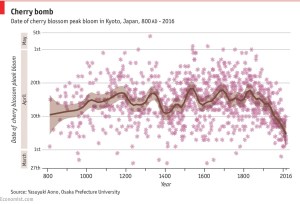
Source: The Economist

Hanami is the Japanese term for contemplating the brevity and beauty of life, by spending time among the fragile blossom that pleases us in the day while braving the frost at night. Sakura is the word for the blossom. A researcher at Osaka Prefecture University, Japan, Yasuyuki Anono, has  made use of all sorts of information available, including classic literature, to chart the première date of the cherry blossom over the centuries. (Btw, “The Tale of Genji” may be the world’s first novel. It is from the tenth century and contains a chapter describing the cherry-blossom festival staged in the emperor’s great hall. – I will get back to contemporary findings re Nature’s positive influence on our mood and behaviour.)

What is clear from the time chart of cherry blossom is that there have always been fluctuations – AND  that during the past half-century or so we see clearly that the blossom appears quite a bit earlier than before, so that it now takes place around 2 April. The findings tally with global info from for example IPCC about ever warmer years lately.  – Is there some phenomenon observed in Indonesia, pointing towards climate change?

WHO IS IN CHARGE IN NATURE?

A well-known international organisation proclaims a rare type of fox with shining white winter-fur as threatened, protected, and listed in the CITES Appendix 1, and a hunter with rotten teeth shoots the fox and sells the fur to have his teeth fixed so he can get married. That’s how it goes. Of course we wish him happiness.  He has the same right to a happy marriage as all of us.

The French movie maker Jean Renoir said in his illustrative The Rules of the Game: “Everyone has their reasons”. That’s it. But something needs to be straightened out.

We need a further inquiry.

The hunter follows what the Market Forces invites him to do.

Can the Market Forces be relied upon to protect Biodiversity?

Can the Market Forces be relied upon to alleviate Forest Loss?

Can the Market Forces be relied upon to alleviate Climate Change?

My answer is NO.